
FRフーディ and sweatshirts are safe for work only when certified to standards like NFPA 2112. A regular hoodie keeps burning and can melt onto skin. VisonSafety manufactures FR garments that self-extinguish, reducing burn injury risk for crews in oil, gas, and electrical trades.
Get a Custom FR Hoodie Quote from VisonSafety
Can hoodies and sweatshirts be flame-resistant?
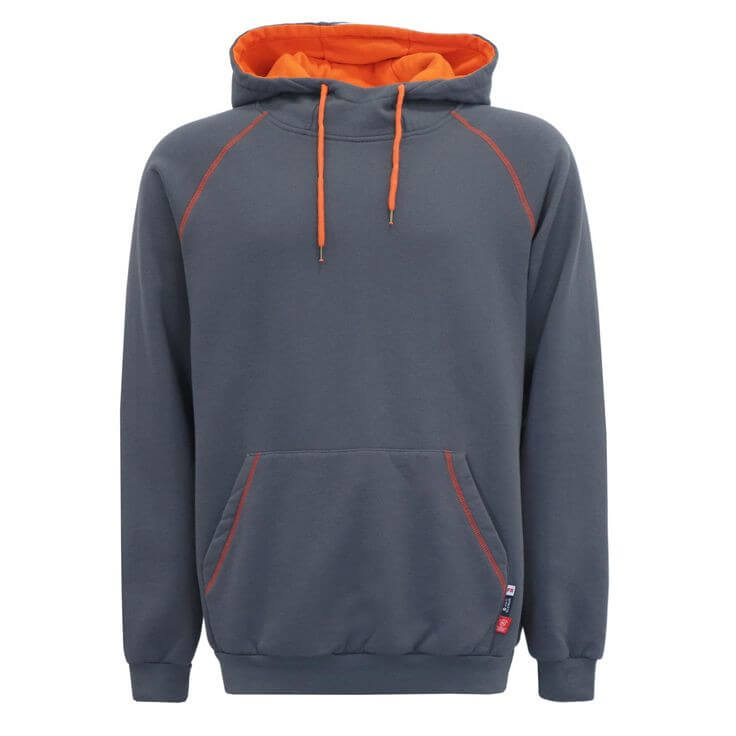
Yes. A fr hoodie resists ignition and self-extinguishes when the flame source disappears. A regular fleece hoodie keeps burning and often melts onto the skin. That difference determines whether a worker walks away from a flash fire or requires emergency care.
The mechanism is straightforward. Flame-resistant garments use fibers that either resist combustion inherently or receive chemical treatment that alters how the fabric responds to heat. When exposed to flame, the material chars instead of igniting. The charred layer forms a barrier that slows heat transfer to the skin. Regular cotton or polyester fleece lacks this property. Polyester melts. Cotton burns. Both behaviors compound injury severity.
How do FR hoodies protect against workplace hazards?
FR hoodies and sweatshirts provide a barrier against flash fires, electric arcs, and heat exposure. These hazards appear without warning in oil and gas operations, electrical maintenance, and utility work. Without that barrier, a worker sustains burns that could otherwise be prevented. The garment does not make the hazard disappear. The garment buys critical seconds for escape.
What makes an FR sweatshirt different from treated cotton?
An fr sweatshirt built from inherently flame-resistant fibers retains its protective properties permanently. The resistance lives in the fiber structure itself. Treated fabrics receive chemical application that bonds to the material. VisonSafety manufactures FR shirts using inherently flame-resistant fibers or durable chemical treatments. Each fabric undergoes resin finishing and thermal curing to lock in protection. The result is permanent resistance that survives repeated laundering.
Safety managers evaluating FRウェアを選ぶべきタイミング should assess hazard type first. Arc flash demands different protection than molten metal splash. The garment specification follows the risk assessment, not the other way around.
What standards certify FR hoodies for work?
Certified FR hoodie garments carry third-party verification against specific thermal hazard benchmarks. The core standards are NFPA 70E, ASTM F1506, and EN ISO 11612. A hoodie without these certifications offers no documented protection against arc flash or flash fire.
Which standard applies to electrical arc hazards?
NFPA 70E governs electrical safety in the workplace. ASTM F1506 specifies the performance requirements for flame-resistant apparel worn by workers exposed to electric arcs. VisonSafety manufactures FR shirts to exceed both benchmarks, with arc ratings meeting CAT 2 through CAT 4. That range covers moderate to severe arc flash exposure levels.
What does EN ISO 11612 cover?
EN ISO 11612 addresses protection against heat and flame for workers in industrial settings. The standard tests garments for limited flame spread, convective heat, radiant heat, and molten metal splash. A certified FR sweatshirt under this standard resists ignition and self-extinguishes when the heat source is removed.
OSHA 1910.269 requires training on arc hazards and the role clothing plays in injury severity. Workers must understand that non-FR layers can ignite and worsen burn outcomes. Certification documents prove the garment passed those tests.
VisonSafety operates within an ISO 9001 quality management environment. The company batch-tests all fabrics and provides OEKO-TEX, CE, and UL documentation as needed. Traceability records are maintained for more than three years.
How do FR hoodies differ from standard fleece?
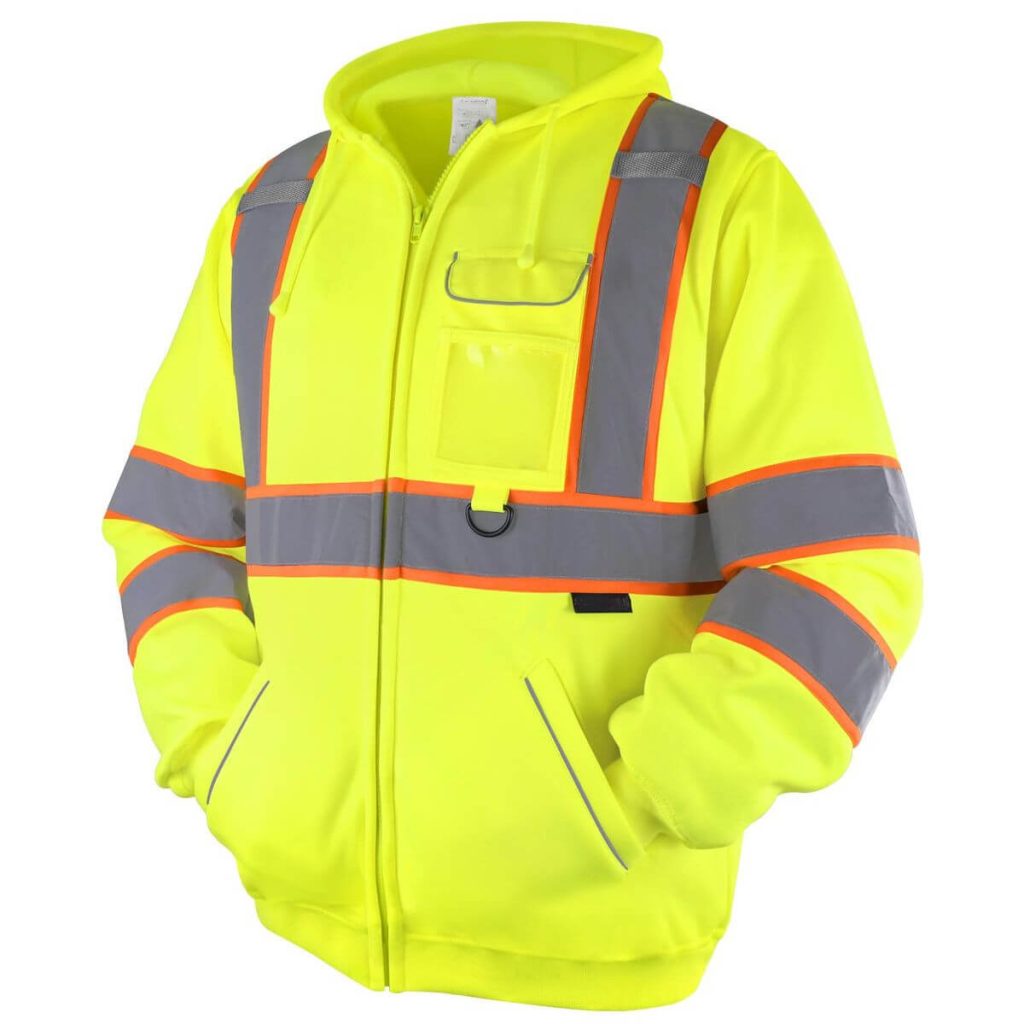
The difference comes down to what happens after the flame source disappears. An FR hoodie is woven from fibers that are either naturally flame-resistant or treated to become that way. Once the flame source is pulled away, the burning stops on its own. Standard fleece keeps burning, and synthetic fleece can melt onto skin while it burns.
That distinction matters for safety managers and procurement specialists. A regular fleece hoodie offers warmth but no protection against arc flash, flash fire, or molten metal splash. An FR hoodie provides the same thermal comfort while adding a self-extinguishing property that standard fleece simply does not have.
Get a Custom FR Hoodie Quote from VisonSafety
What makes the fabric behave differently?
The fiber chemistry drives the performance gap. Naturally flame-resistant fibers resist ignition at the molecular level. Treated fibers receive a chemical application that interrupts the combustion cycle. Standard fleece, typically polyester or cotton-polyester blends, lacks both mechanisms. Polyester melts. Cotton burns steadily. Neither self-extinguishes.
How does manufacturing quality control affect FR performance?
Fabric performance only matters if it survives production consistently. VisonSafety conducts full inspection and fabric testing from fiber generation to final garment. Each production lot is recorded and traceable for three years. That documentation supports compliance audits and gives procurement teams a verifiable chain of evidence for every shipment.
An FR sweatshirt adds another layer to the comparison. These garments are lightweight, flexible, and durable while providing flame resistance for worker safety. Standard fleece sweatshirts offer none of that protective function. The weight and flexibility matter because workers in oil and gas, utilities, and electrical trades need full range of motion without sacrificing thermal protection.
The practical consequence is straightforward. A spark that singes an FR garment leaves the worker with a damaged garment. The same spark on standard fleece leaves the worker with a burn injury. That gap defines the entire category.
What are safe layering rules for FR sweatshirts?
Safe layering under an FR sweatshirt starts with one non-negotiable rule. The base layer must not melt. A synthetic t-shirt turns into a skin-bonded hazard during an arc flash. The golden rule demands non-melting base layers, specifically cotton or inherently flame-resistant materials. A polyester blend worn underneath an FR hoodie defeats the outer garment’s protection entirely. The outer fabric self-extinguishes while the inner layer continues to burn.
How does layering affect arc rating performance?
Layering changes the total thermal protection value. Each garment adds its own arc thermal performance value (ATPV), measured in calories per square centimeter. Safety managers match the combined calorie rating to the workplace’s specific hazard level. A single FR sweatshirt might provide 8 cal/cm² of protection. Adding an FR base layer pushes that number higher. The system works only when every layer contributes flame resistance. One non-FR garment collapses the entire protective envelope.
What hardware risks come with FR sweatshirt design?
Drawstrings create entanglement hazards around rotating equipment. Zipper hardware conducts heat differently than fabric. These mechanical risks demand careful specification during procurement. A hoodie with exposed metal zippers transfers thermal energy faster than the surrounding material. Drawstrings catch on machinery and pull workers into danger zones. The safest designs eliminate unnecessary hardware or shield it behind protective flaps. Procurement teams evaluating who needs FR clothing must audit these details alongside calorie ratings. A compliant ATPV number means nothing if a drawstring pulls a worker into a lathe.
Which work environments need FR hoodies most?
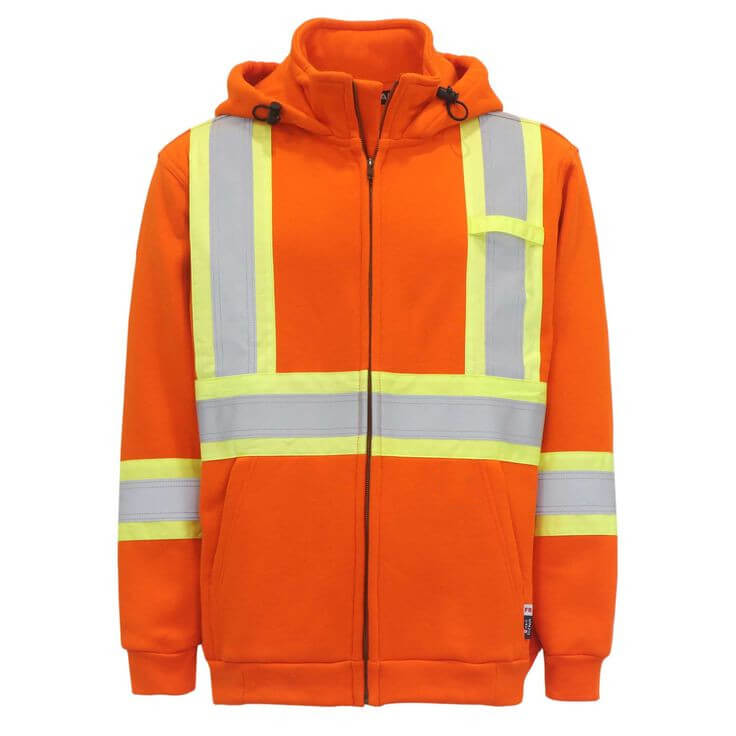
Electric utilities, oil and gas extraction, and petrochemical processing demand FR hoodie and FR sweatshirt protection more urgently than any other sectors. A single arc flash in a substation reaches temperatures hotter than the sun’s surface, turning a cotton hoodie into a fuel source in under a second. Without flame-resistant fabric, the garment ignites, melts, and continues burning against skin long after the initial hazard passes.
Get a Custom FR Hoodie Quote from VisonSafety
What makes electrical work the highest-risk category for FR hoodies?
Electric utilities and linemen operate under NFPA 70E compliance mandates. Arc flash hazards produce intense heat, molten metal spray, and pressure waves. An FR sweatshirt engineered to self-extinguish prevents the secondary burn injuries that ordinary clothing causes when it catches fire and stays lit. The standard requires garments to resist ignition and limit burn injury to the wearer’s body.
Why do oil and gas operations require NFPA 2112-rated FR sweatshirts?
Oil and gas and petrochemical processing environments demand NFPA 2112 compliance for flash fire protection. Workers face sudden vapor cloud ignitions that engulf a body in flame for two to three seconds. FR sweatshirts designed for these professions resist the fire, self-extinguish once the fuel source passes, and give the worker those critical seconds to escape. The same protection extends to solar installation crews, where electrical arcs and combustible materials create parallel risks.
Electric utilities and linemen: NFPA 70E compliance for arc flash hazards
Oil and gas extraction: NFPA 2112 compliance for flash fire events
Petrochemical processing: Continuous exposure to flammable atmospheres
Solar installation: Electrical arc risks during panel and inverter work
The common thread across these environments is simple. Regular fleece burns. FR fabric does not. For safety managers outfitting crews in any of these sectors, the specification is not optional. It is the difference between a near miss and a fatality report.
よくある質問
Are FR hoodies safe to wear at work?
FR hoodies certified to standards like NFPA 2112 self-extinguish and reduce burn injury risk for workers in oil, gas, and electrical trades.
What standards certify FR hoodies for workplace safety?
Certified FR hoodies carry third-party verification against NFPA 70E, ASTM F1506, or EN ISO 11612 thermal hazard benchmarks.
結論
The decision is binary: standard fleece burns and melts onto skin, while certified FR hoodies and sweatshirts self-extinguish and limit burn injury. For safety managers in electric utilities, oil and gas, or petrochemical processing, the specification is not optional. Procuring garments that meet NFPA 70E or NFPA 2112 compliance turns a garment from a fuel source into a protective barrier, buying workers the critical seconds needed to escape a flash fire or arc flash without a fatality.
 English
 Deutsch
 Français
 Polski
 Português do Brasil
 Español
 日本語
 Русский
 العربية
 Italiano
 Nederlands
 Türkçe
 한국어